


Already own a portable generator?
Power your home from it safely, without extension cords.
A generator hookup lets your portable generator run the circuits you choose (the fridge, the furnace, the well pump, the lights) through one cord plugged into an inlet on the outside of your house. Tell us your generator model and what you want to power, and we’ll tell you what it takes at your house.
What the installation does
- A power inlet on the outside wall. A weatherproof inlet box where your generator cord plugs in. No more running cords through a cracked-open door or window.
- A connection from the inlet to your panel. Wired to a dedicated breaker in your electrical panel.
- A transfer device at the panel. An interlock kit or a manual transfer switch makes it physically impossible for generator power and utility power to be on at the same time. That protects utility line workers, your generator and your wiring, and it’s what makes the hookup safe and code-compliant.
- During an outage: set the generator up outside, plug in one cord, switch the panel over, and turn on the circuits you want.
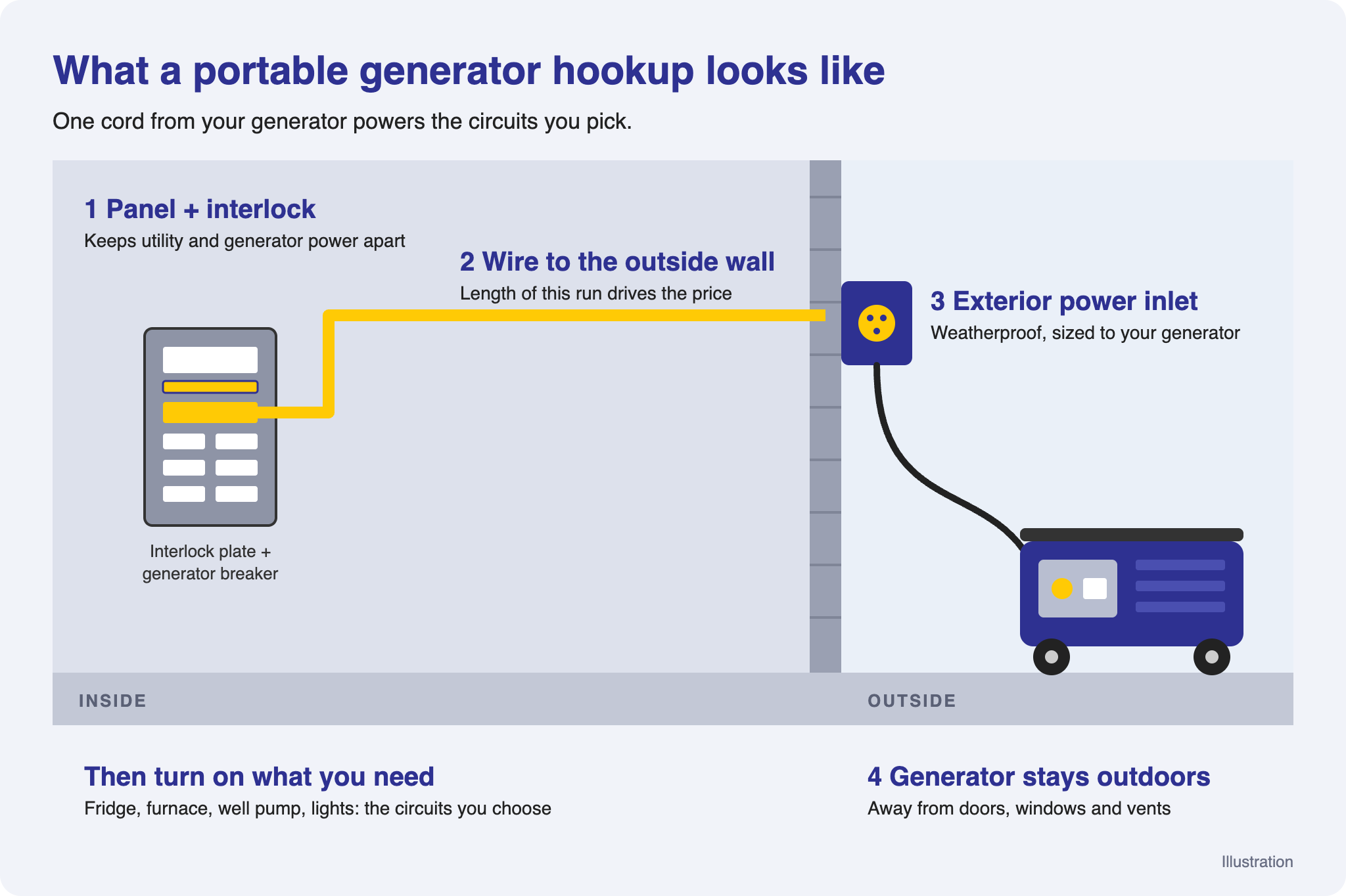
Never plug a generator into a dryer or wall outlet with a double-ended cord. It sends power back into the utility lines and is a serious shock and fire hazard.
What we evaluate before quoting
- Your generator. Its running and surge wattage, whether it puts out 240V or only 120V, which outlet it has (for example a 30-amp L14-30 twist-lock or a 50-amp outlet), and how its neutral is set up. That decides the inlet, the cord and the breaker size.
- Your panel. The brand and model (interlock kits are made for specific panels), whether there’s room for the generator breaker, and the panel’s overall condition.
- The connection location. Where the inlet goes, usually on an exterior wall close to the panel, and where the generator will sit. It has to run outdoors, well away from doors, windows and vents, because of carbon monoxide.
- The circuits you want to run. What matters to you during an outage, checked against what your generator can actually carry.
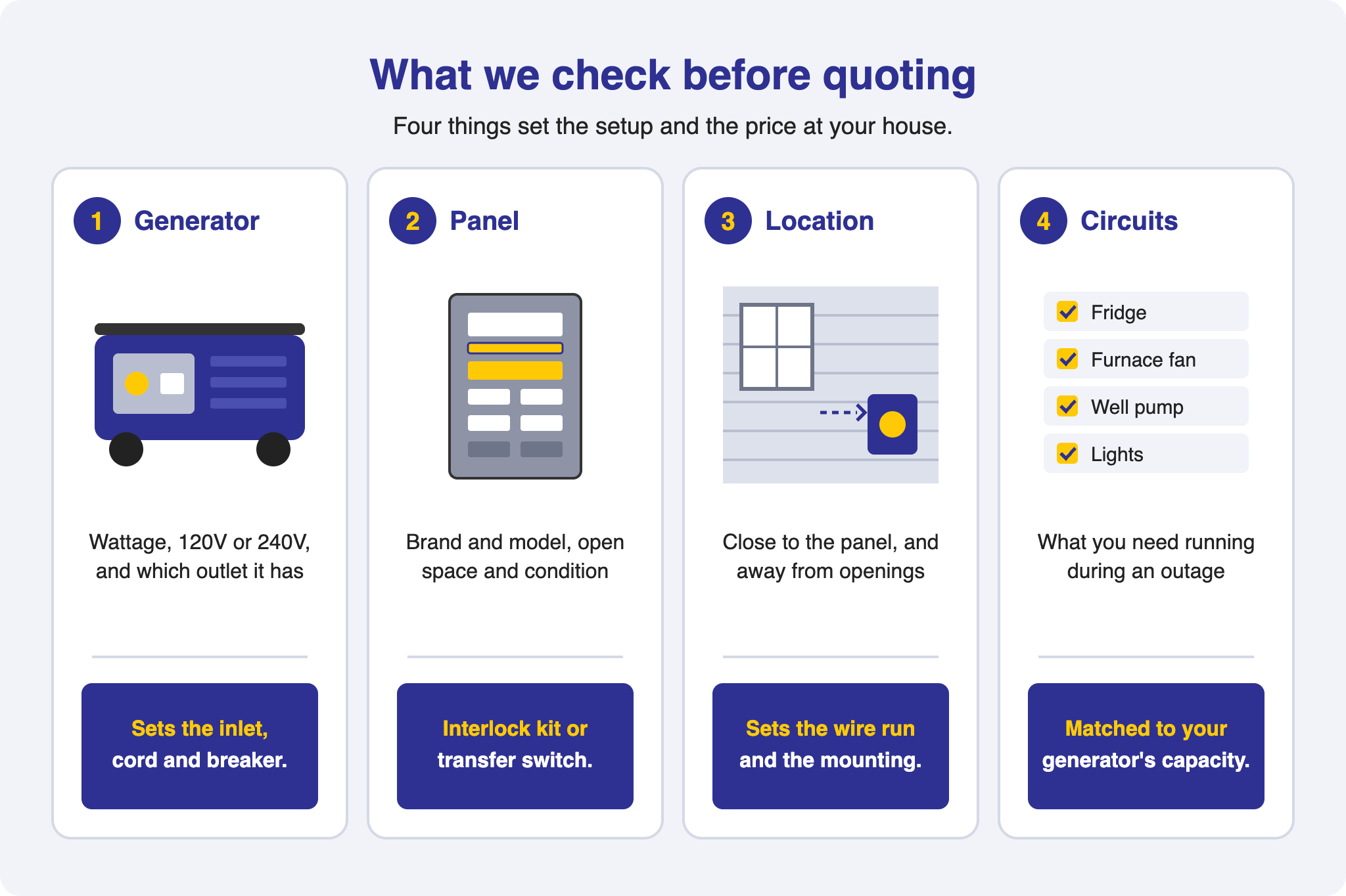
What can a portable generator run?
Common choices:
- Refrigerator and freezer
- Gas furnace blower (for heat in a winter outage)
- Well pump and sump pump
- Lights and a few outlets for internet, phones and a TV
- Garage door opener
Usually too much for a portable generator: central air or a heat pump, an electric range, an electric dryer and an electric water heater. We’ll tell you what your model can handle and which loads to run one at a time.
Why the setup and price vary by property
- Distance between the panel and where the inlet can go, and how the wire has to travel (through a garage, a crawlspace, an attic or finished walls)
- Your panel: whether an interlock kit is available for it or a transfer switch makes more sense, and whether it has open space
- Generator size: a 50-amp hookup needs heavier wire and a larger inlet than a 30-amp hookup
- The exterior wall: siding, brick and stone each mount differently
- Permit and inspection requirements where you live
That’s why we quote each house after we know the generator and the panel, not from a flat price.
Have this ready
On the booking form, choose Electrical. In the Message box, start with “Generator Hookup Quote”, then add:
- Your generator’s make and model (a photo of its outlet panel helps)
- What you want to power during an outage
- Where your electrical panel is, and where you’d set up the generator outside
- Optional but helpful: photos of the panel with the door open and the panel label (the office can text you a number to send them to)
FAQ
Interlock kit or transfer switch?
An interlock lets you run any circuit in your panel, and you choose what’s on. A manual transfer switch is wired to a set group of circuits. Which one fits depends on your panel and what you want to power. We’ll recommend one when we see it.
Can I keep using extension cords instead?
Cords work for plug-in appliances, but they can’t power hardwired equipment like a furnace, a well pump or ceiling lights. The hookup can.
Will it run my whole house?
Usually not with a portable generator. It runs the essentials you pick. If you want the whole house covered automatically, ask us about a standby generator.
I don’t have a generator yet. Can you help?
Yes. Tell us what you want to power and we’ll tell you what size and outlet type to look for.
Send us your generator model and what you want to power, and we’ll come back with a clear quote.


